We use cookies to make this site work. We'd also like to set optional cookies so we can understand how the site is used and improve it. We will not set optional cookies unless you accept them. You can change your choice at any time from the Cookie settings link in the footer.
Strictly necessary cookies
These cookies are required for the site to work. They store your cookie preferences and keep your session secure. They are exempt from consent under PECR Regulation 6(4) because they are essential to deliver the service you have requested.
Optional cookies
Optional cookies help us understand how the site is used and provide additional features such as analytics, accessibility tools and translation. We will only set them if you accept.
Practice Matters
News of our patients, from the team at Fallodon Way Medical Centre
Issue 1: Autumn 2026
|
IN THIS ISSUE
|
A welcome from the practice team
Welcome to the first edition of Practice Matters, our new quarterly newsletter for patients of Fallodon Way Medical Centre. A lot happens at the surgery between your visits — new staff, new services, changes to the way general practice works nationally — and we want to keep you informed all year round, not just when you're unwell.
In each edition you'll find practice news, an introduction to members of our team, health advice for the season ahead, and updates on the work we do with our neighbouring practice as part of Affinity Primary Care Network.
Practice Matters is our response to a request from our Patient Participation Group (PPG), who asked to know more about the practice, its team and its services. Thank you to our PPG for the suggestion, and to all our patients for your continued support and patience.
We’re welcoming new patients
Fallodon Way Medical Centre is open to new patients. If you have family, friends or neighbours who have recently moved to the area, or who are looking for a GP practice, please let them know we’d be happy to welcome them.
Registering is quick and easy. New patients can register online through our website, www.fwmc.org.uk, or by asking at reception. Our website also shows the area we cover, so people can check they live within our practice boundary.
More GP appointments. We have added two additional GP sessions per week, and we are looking to add a further session, giving our patients more opportunities to see a GP. As a training practice, we also benefit from GP trainees who add to the care we can offer.
News from the practice
Staff news
We are delighted to welcome Deanna Walkom, who has joined us as our new Nurse Manager. Deanna brings a wealth of experience in nursing and in managing people and nursing teams within the NHS, and we're thrilled to have her on board. We will also shortly be saying a fond farewell to two long-standing members of our team, and we are currently recruiting a new Health Navigator. Finally, we're pleased to announce that we have recruited a new Pharmacy Technician, who joined the practice in August 2026.
Appointments and access
During the summer, our team answered around 135 calls every day. For routine appointments and requests, the best way to contact us remains the Accurx online form on our website, www.fwmc.org.uk. It is open throughout the working day and lets our team pick up your request quickly. You can still phone the practice if you prefer, but using the online form where you can helps keep our phone lines free for patients who find online access difficult.
Missed appointments
Every appointment that is missed without notice is time that could have been given to another patient who needed it. If you can no longer attend, please let us know as early as possible, even on the day, so we can offer the appointment to someone else. Thank you for helping us make the most of every appointment.
Our building
For almost five years we have been working hard to secure funding to expand the surgery and move our Admin team out of the current portacabin and into a proper building. Unfortunately, securing this funding has proved very difficult, and the practice may need to make changes to where our Admin team is accommodated from August 2027. Please be assured this will not affect the care and services you receive — we will keep you updated in future editions as plans develop.
We’re welcoming new patients
Fallodon Way Medical Centre doesn't work alone. We are part of Affinity Primary Care Network (PCN), which is made up of two practices: Fallodon Way Medical Centre and Westbury-on-Trym Primary Care Centre. Together, we care for a combined population of over 20,000 patients in north and west Bristol.
Working as a network means the practices can share staff, services and expertise that would be difficult for one surgery to provide on its own. Through the PCN you may be offered appointments with roles such as clinical pharmacists, first-contact physiotherapists, mental health practitioners, social prescribing link workers and care coordinators — all part of your extended practice team. The PCN also delivers joint projects such as vaccination programmes and enhanced access appointments in the evenings and at weekends.
In their own words: the people behind your care
There's much more to a GP surgery than the doctor you see in the consulting room. In every edition we'll introduce you to a different member of the team — clinical and non-clinical — so you can get to know the people working behind the scenes.
|
Five minutes with… Dr Lucy Burnand, GP Partner In each edition we’ll sit down with a different member of the team. First up: our GP Partner, Dr Lucy Burnand. What inspired you to become a GP? Throughout my medical training I enjoyed the full spectrum of medicine. In general practice, we never know what concerns patients may bring to us on any given day, and I really value that variety. I was also drawn to the opportunity to build lasting relationships with patients. We always do our best to provide continuity of care, although this can sometimes be challenging, as each GP in our practice looks after more than 1,000 patients. We therefore prioritise continuity for patients with long-term health conditions and those receiving end-of-life care, for whom an ongoing relationship with the same clinician can be especially important. What does a typical day look like for you? Every day is different, which certainly keeps us on our toes! Patient appointments are the most visible part of our work, but a great deal also happens behind the scenes. Those doctors who work both morning and afternoon sessions are usually in the practice for at least 10–11 hours, which explains why they can’t be in every day. I usually arrive early to begin working through my inbox. This includes reviewing blood test results, acting on advice from hospital clinic letters and reading discharge summaries. I then start my clinic. We see between 13 and 15 patients in every morning and afternoon clinic. At midday, we meet with our care coordinators, senior pharmacist and nurse practitioners to discuss patients with complex needs and allocate doctors to visit housebound patients. Between morning and afternoon clinics, we may carry out home visits, or attend meetings with district nurses, the pharmacy team or the management team. If time allows, I join my colleagues for a quick walk around the block to stretch my legs and get some fresh air. I usually cover the duty session on Thursday afternoon. This involves assessing patients who are acutely unwell, reviewing patients in the treatment room who our nurses may be concerned about, speaking with paramedics who are attending our patients, and dealing with urgent prescription requests. At the end of the day, I complete further administrative work and write referrals for patients I have seen that day. Then I am ready to head home! What is the best part of working at Fallodon Way? Without a doubt, it is our team. We have a fantastic group of care navigators, administrative and management staff, doctors, nurses, care coordinators and pharmacy professionals. There is a wonderful team spirit, and everyone works together to provide the best possible care for our patients within the resources allocated to us. What piece of health advice do you give most often? I am a firm believer in the principle that prevention is better than cure. Regular exercise – ideally at least 150 minutes each week – alongside a balanced diet and avoiding smoking can make a huge impact on improving physical and mental health. Patients who make these changes often feel much better and may even be able to reduce or stop certain medications. What small change could patients make to help the practice run more smoothly? Downloading the NHS App is a simple but valuable step. Patients can use it to order repeat medication and view test results and medical records online. This also helps to keep our telephone lines available for patients who find online access difficult. What common health myth would you like to put to rest? The idea that cold weather causes colds. Colds are caused by viruses, not by cold air itself. However, colder weather tends to bring people indoors, where they spend more time together in enclosed and sometimes poorly ventilated spaces. This makes it easier for viruses to spread. So please remember to book in for your flu and COVID jabs if you are eligible for them! Tea or coffee – and how many cups a day? Tea – dare I admit, up to six cups a day… although I do try to drink plenty of water in between. |
Advice from our nursing team: why your annual review mattersIf you live with a long-term condition such as asthma, COPD, diabetes, high blood pressure or heart disease, you'll be invited once a year for an annual review — usually around your birthday month. It can be tempting to skip it if you're feeling well, but please don't. Your annual review is how we:
To get the most out of your review: have any blood tests done beforehand if we've asked you to, bring an up-to-date list of your medicines (or your repeat slip), and jot down anything you'd like to discuss. When your invitation arrives — by text, letter or a message on your prescription — please book in. Ten minutes with us once a year can prevent a hospital visit later. |
Team wellbeing
Netball, ‘friendly’ style
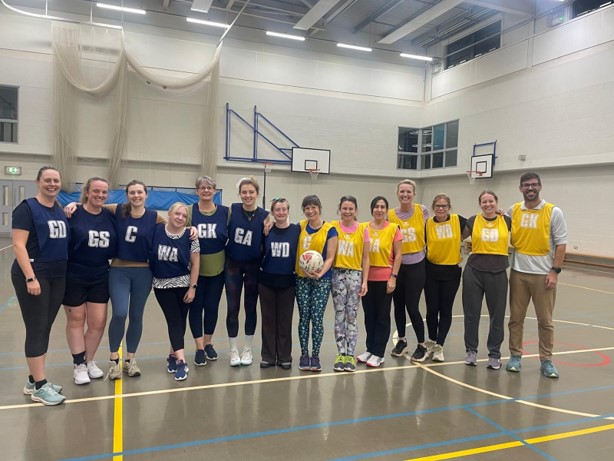
Our team recently swapped keyboards and stethoscopes for netball bibs and met up for a friendly game of netball. We say ‘friendly’… for a group of people who spend their days being caring and patient, there were some remarkably competitive interceptions! In the end we were having so much fun that nobody actually kept score, so the question of who won will have to be settled at the rematch. Maybe next time.
Navy bibs or yellow bibs? We’re still not saying who won!
A digital Walk Across Africa
Throughout October and November, the team is taking on a digital Walk Across Africa: a team step challenge where every step we take counts towards a virtual journey across the continent. Everyone is really excited about it, and we’ll let you know how far we get in the next edition.
Learning to care: students, trainees and training practices
You may sometimes see a medical student sitting in on your appointment, or be seen by a GP trainee. Here’s a quick guide to who they are and why they’re here.
Medical students
Medical students are studying at university to become doctors, a course that usually takes five or six years. Part of their learning happens in GP surgeries, where they observe consultations and, under close supervision, may take a history or carry out a simple examination. They are not yet qualified doctors and always work alongside a qualified GP. We’ll always ask your permission before a student joins your appointment, and it’s absolutely fine to say no. It won’t affect your care in any way.
GP trainees
GP trainees, or junior doctors (sometimes called GP registrars or doctors in training), are fully qualified doctors. They have completed medical school and at least one or two further years working in hospitals, and are now doing specialist training in general practice. For many of them, this will lead to becoming a GP. This training takes at least three years and includes time in both hospitals and general practice. Trainees see patients independently, but are supported by an experienced GP supervisor whom they can discuss cases with at any time. As part of their assessment, trainees may occasionally ask if they can video record a consultation. This is only ever done with your written consent, and you can decline.
Fully qualified GPs. A fully qualified GP has completed all of this training, passed the Royal College of General Practitioners’ exams (MRCGP), and is listed on the General Medical Council’s GP Register. GPs continue learning throughout their careers and go through regular appraisal and revalidation to keep their licence to practise.
What is a training practice?A training practice is a surgery that has been approved to teach and supervise doctors in training. To earn this approval, the practice is inspected and must meet high standards, and its GP trainers complete additional qualifications and specific training in medical education. Being a training practice means our clinicians keep their own knowledge up to date, and it helps grow the next generation of GPs – something the NHS badly needs. Training doctors is something we’re proud of, and it has a way of coming full circle: two of our own GPs, Dr Kuur and Dr Burnand, were once medical students here at Fallodon Way Medical Centre. Your choice matters. If you’d prefer not to have a student present, or would rather see a particular clinician, just let our reception team know when you book. |
What can a GP trainee do?Because GP trainees are fully qualified doctors, they can do most of what you’d expect from a GP appointment. They can assess and examine you, make a diagnosis, prescribe medication, order blood tests and scans, refer you to hospital specialists, issue fit notes, carry out reviews of long-term conditions and arrange follow-up care. They can also do telephone consultations and home visits. What’s different? Trainees work under supervision, so some things work a little differently:
|
Looking after yourself this season
- Autumn vaccinations. Our autumn vaccination programme is now under way. We held our first flu vaccination clinic on Saturday 3 October 2026, and there is another flu clinic on Saturday 10 October and a combined flu and COVID-19 clinic on Saturday 17 October. Eligible patients should have received a text message from the practice inviting them to book an appointment. If you think you're eligible but haven't heard from us, please get in touch.
- Pharmacy First. Your local pharmacy can assess and treat seven common conditions — including sore throats, earache, sinusitis and urinary infections in women — without a GP appointment.
- NHS App. Order repeat prescriptions, view your records and manage appointments from your phone. Ask at reception if you'd like help getting started.
- Health checks and screening. If you're invited for an NHS Health Check or for bowel, breast or cervical screening, please take up the offer — these appointments save lives.
Health awareness this October
|
ADHD Awareness Month, 1–31 October ADHD is a neurodevelopmental condition affecting both children and adults. It involves a long-term pattern of inattention and/or hyperactivity-impulsivity that interferes with daily life or typical development. People with ADHD may also have difficulties with:
There are two main types of ADHD, and some of the symptoms of each are listed below. Inattentive presentation
Hyperactive-impulsive presentation
A third type, combined ADHD, includes symptoms of both. You can find out more about ADHD, its symptoms, diagnosis and the support available on the ADHD UK website: adhduk.co.uk. ADHD Awareness Month aims to share awareness, information and support worldwide, and people with ADHD are invited to share their art, stories and memes to inform and inspire others. Find out more and get involved at adhdawarenessmonth.org. |
Breast Cancer Awareness Month, 1–31 OctoberBreast cancer is the most common cancer in the UK. It mainly affects women, but men can get it too. If you notice one or more of the symptoms below, it doesn’t mean you definitely have cancer, as they can all be caused by other things. But please contact us to get checked: the earlier breast cancer is diagnosed, the easier it is to treat. Symptoms include:
Breast Cancer Awareness Month is a global campaign held every October to raise awareness of breast cancer, promote earlier diagnosis and support those affected. There are lots of ways to take part. You can help raise awareness of the signs and symptoms, perhaps by holding an awareness event or encouraging friends, family and colleagues to check their breasts regularly. You can also run or join a fundraising activity, or ‘Wear it pink’ in October to show your support. The Breast Cancer Now website has lots of ideas and resources: breastcancernow.org. |
Sober October 1st–31st OctoberSober October is a fundraising challenge that asks people to go alcohol-free for the month of October. It is an opportunity to make a healthy lifestyle change while raising vital funds to support all those affected by alcohol harm.
You can find out more about the risks associated with drinking alcohol at https://www.nhs.uk/live-well/alcohol-advice/the-risks-of-drinking-too-much/. |
Have your say
|
Help us shape your surgery Your feedback genuinely changes how we work. Here's how to share it:
You said, we did: At our last PPG meeting, patients asked for a board showing photos and names of our staff, so it's easier to know who's who. This is now on display in the reception area — do take a look next time you're in. |
Useful contacts
|
Fallodon Way Medical Centre |
0117 962 0652 · www.fwmc.org.uk · 13 Fallodon Way, Henleaze, Bristol BS9 4HT |
|
Out of hours / urgent advice |
NHS 111 (phone or 111.nhs.uk) |
|
Emergencies |
999 |
|
Repeat prescriptions |
Via the NHS App, practice website or your nominated pharmacy |
|
Feedback & complaints |
[Practice Manager name / email] · Friends & Family Test cards at reception |
|
Get Practice Matters straight to your inbox Enjoyed this edition? Sign up and we’ll email you each new issue, free, four times a year. 1. Scan the QR code with your phone camera. 2. Enter your name and email address, and choose “Yes” to give your consent. 3. Press submit – that’s it. You can unsubscribe at any time. No smartphone? Email bnssg.fwmc.admin@nhs.net with “Practice Matters sign-up” and your name, or ask at reception. |
|
 Scan to sign up
|
Practice Matters is produced by Fallodon Way Medical Centre for our patients. If you'd like a large-print copy, or have an idea or question for a future edition, please let us know — we'd love to hear from you. |